


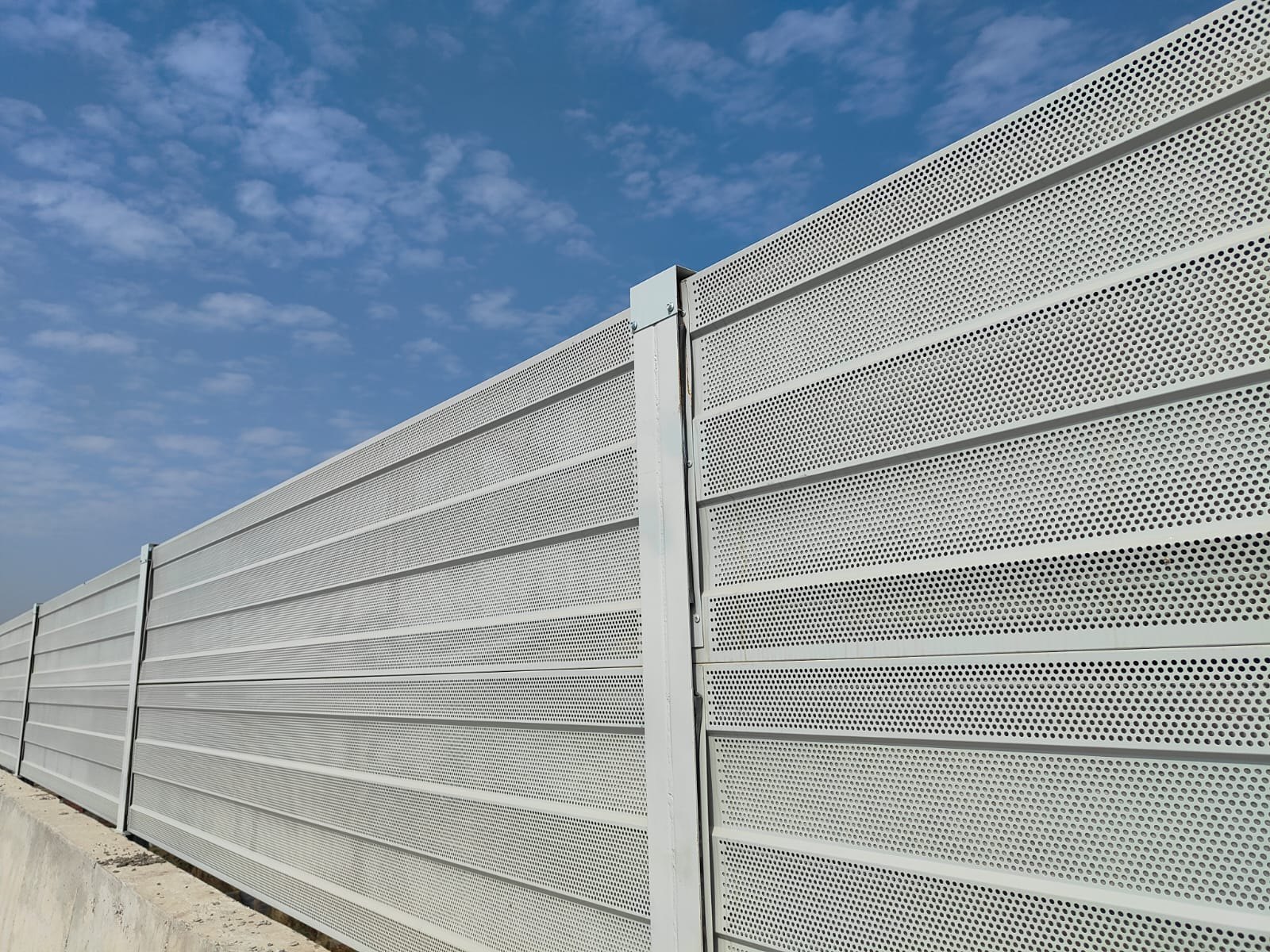

On paper, there are plenty of ways to control noise on a construction site. You have rigid barriers, modular walls, full enclosures, and even permanent acoustic structures. But in real-world projects, especially in tight or fast-moving environments, contractors often lean towards something much simpler: sheet-based sound barriers.
- When Space Is Extremely Limited
- When the Site Layout Keeps Changing
- When Installation Time Is Limited
- When Working at Height
- When Targeting Specific Noise Sources
- When Budget Constraints Are a Factor
- When Transport and Logistics Are Challenging
- When Weather Conditions Require Flexibility
- When Compliance Needs to Be Demonstrated Quickly
- Where Sheet-Based Solutions May Not Be Enough
- The Real Advantage: Adaptability
- Final Thoughts
These are flexible acoustic sheets that can be attached to scaffolding, fencing, or temporary frames. They might not look as solid as traditional barriers, but in many situations, they are the more practical choice.
So when do contractors actually prefer using sheet-based solutions over rigid systems?
When Space Is Extremely Limited
One of the biggest reasons contractors choose sheet-based barriers is simple: lack of space.
In dense urban projects, there is often no room for freestanding acoustic walls. Access routes, storage areas, and safety zones already compete for every bit of available space.
Sheet barriers solve this by:
- Attaching directly to existing structures
- Taking up minimal ground footprint
- Fitting into tight or irregular layouts
Instead of building something new, contractors use what is already there, like scaffolding or hoardings, and turn it into a noise control system.
When the Site Layout Keeps Changing
Construction sites are constantly evolving. Work zones shift, access points move, and different phases require different setups.
Rigid barriers can be time-consuming to dismantle and reinstall. In contrast, sheet-based systems are much easier to adjust.
Why This Matters
- Sheets can be removed and repositioned quickly
- They adapt to new work areas without major effort
- They support phased construction without slowing progress
For projects that move fast or change frequently, flexibility becomes more valuable than rigidity.
When Installation Time Is Limited
Time is always a critical factor in construction. Some projects require noise control measures to be installed quickly, especially when work is already underway or when regulations demand immediate action.
Sheet-based barriers are ideal in these situations because:
- They are lightweight and easy to handle
- Installation does not require heavy equipment
- They can be set up by smaller teams in less time
This makes them a practical option for urgent deployments or short-notice requirements.
When Working at Height
On multi-storey projects, noise is not just generated at ground level. Activities like drilling, cutting, and installation can take place several floors up.
Installing rigid barriers at height is often impractical. Sheet-based solutions, however, can be attached directly to scaffolding.
Common Use Cases
- Wrapping scaffolding structures
- Creating vertical noise containment zones
- Reducing sound spread from upper floors
This vertical flexibility is one of the biggest advantages of sheet systems.
When Targeting Specific Noise Sources
Not all noise comes from the entire site. Often, it is concentrated in specific areas, such as:
- Cutting stations
- Generator zones
- Concrete processing areas
Instead of installing large perimeter barriers, contractors may use sheet-based systems to create localised enclosures.
Benefits
- More efficient use of materials
- Better control at the source
- Reduced need for full-site coverage
This targeted approach can be more effective in certain situations than relying on large, static barriers.
When Budget Constraints Are a Factor
Cost is always part of the decision-making process.
Sheet-based barriers are generally more cost-effective than rigid systems because:
- They require less material
- Installation is quicker and less labour-intensive
- They can often be reused across multiple projects
For short-term or smaller-scale projects, investing in heavy-duty structures may not be practical. Sheets provide a balanced solution between performance and cost.
When Transport and Logistics Are Challenging
Getting materials onto a site is not always straightforward, especially in busy urban areas.
Large rigid panels can be difficult to transport and store. They take up space and may require special handling.
Sheet-based barriers, on the other hand:
- Are lightweight and compact when not in use
- Can be transported in bulk more easily
- Require less storage space on site
This makes them particularly useful in locations with restricted access or limited staging areas.
When Weather Conditions Require Flexibility
Outdoor construction sites are exposed to wind, rain, and changing weather conditions.
Rigid barriers can face significant wind loads, especially when installed over large areas. This requires strong anchoring and additional structural support.
Sheet-based systems offer a different advantage:
- They can flex under wind pressure rather than resist it completely
- They are less likely to act as large rigid surfaces that catch wind
- They can be reinforced or adjusted more easily
While they still need to be secured properly, their flexibility can make them more manageable in certain environments.
When Compliance Needs to Be Demonstrated Quickly
In regulated environments, especially near residential zones, contractors may need to show that noise control measures are in place before work continues.
Sheet-based barriers provide a fast way to demonstrate action.
They may not always be the final solution, but they can:
- Provide immediate noise reduction
- Show visible mitigation efforts
- Help meet initial compliance requirements
From there, contractors can refine or expand their setup as needed.
Where Sheet-Based Solutions May Not Be Enough
While sheet barriers are versatile, they are not always the best choice.
They may be less suitable when:
- Very high levels of noise reduction are required
- Low-frequency noise is a major issue
- Long-term, heavy-duty installations are needed
- Full acoustic enclosures are necessary
In these cases, contractors often combine sheet systems with more rigid solutions rather than relying on them alone.
The Real Advantage: Adaptability
If there is one reason contractors consistently choose sheet-based sound barriers, it is adaptability.
They work well in:
- Tight spaces
- Changing environments
- Fast-paced projects
- Multi-level construction sites
Instead of forcing the site to fit the barrier, sheet systems adapt to the site.
Final Thoughts
Sound barrier sheets might not look as robust as traditional acoustic walls, but in many real-world construction scenarios, they are the more practical and efficient choice.
Contractors prefer them when space is limited, layouts are constantly changing, installation needs to be fast, or budgets are tight. Their flexibility, ease of use, and adaptability make them especially valuable in complex urban environments.
That said, they are not a one-size-fits-all solution. The best results often come from using them as part of a broader noise control strategy.
In construction, effectiveness is not just about strength. It is about choosing the right tool for the conditions at hand.